

Introduction
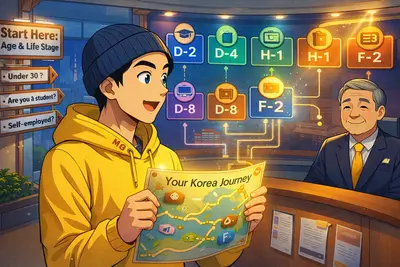
Many of you are wondering about how to live in Korea, and through my personal experiences, as well as helping countless others navigate their own journeys, I've learned that there are many different paths you could take when settling in Korea. However, these paths vary significantly depending on your age, occupation, and life circumstances.
Here's the reality: before you commit to something long-term like permanent residency (which isn't easy to obtain), you need to go through the cycle of different mid-term visas that allow you to stay in Korea anywhere from 3 months up to 2 years. In this article, I want to show you how you can obtain different "easy" visas that will eventually pave your way toward permanent residency.
If I had to restart my visa journey and make these choices again, knowing what I know now, this is exactly how I would approach it.
Age 18-25 (Student Phase)
🎓 Exchange Student Visa (D-2): The Gateway to Korea
Recommended Age: 20-25
Difficulty: Easy
Personal Experience & Recommendation
While I was studying electrical engineering at university, I discovered that my school had a partner university in Korea. I went to the international office to gather information, but back in 2014, Korea wasn't a popular exchange destination yet, and the office worker didn't really know how to help me.
That's when I took matters into my own hands. I tracked down senior students who had done exchanges to Korea and asked them countless questions. I gathered all the information, applied for the program, and even ended up sharing the entire process with the international office worker to help future students.
As a young university student, I would highly encourage everyone to do a semester abroad, not really for the educational reasons, but rather for the life experience. Being abroad opens your mind in ways you cannot imagine.
Don't think you're wasting time while everyone else is "getting ahead" in their careers. I'm telling you that 6 months to 1 year abroad won't make a difference in your career timeline, but it will open up countless opportunities later in life that you can't even foresee right now.
Requirements
- Be enrolled in a university that has a partner university in Korea
- Take a semester or academic year off from your home university
- Sometimes able to get credits from courses taken abroad
- Meet your home university's GPA and academic standing requirements
Why It's Easy
Most of the paperwork is handled by the universities on both ends. Your host university in Korea will provide you with necessary documents and guide you through the process. Your home university's international office will also support you with the application, making it very straightforward to follow.
Key Benefits
- University support: Both your home and host universities handle most administrative tasks
- Academic credits: Your studies often count toward your degree
- Life experience: Opens your mind and creates opportunities you can't imagine
- Network building: Make connections with Korean and international students
- Cultural immersion: Live like a local student in Korea
Duration
Typically one semester (6 months) or one academic year (1 year)
Age 25-30 (Early Career)
🌴 Working Holiday Visa (H-1): Experience Korea as an Adult
Recommended Age: 25-30
Difficulty: Easy-Medium
Personal Experience & Recommendation
Before turning 30, I wanted to experience Korea again as an adult. I was curious about living in Korea for one year to test if I could really imagine settling down here long-term. Well, as you now know, I'm still in Korea and doing great!
This visa is fantastic because it gives you a whole year to live in Korea without strings attached. You get the experience of living abroad for one year with relatively low requirements during your stay. Think of it as a 1-year tourist visa with benefits.
Many people think they need to work because it says "working" holiday, but the focus is on holiday and experiencing the country. The working part is just voluntary and optional.
Requirements
- Your country must have a working holiday agreement with Korea (check eligibility)
- Must be between 18-30 years old (age limit varies by country)
- Proof of sufficient funds (usually around $2,500-3,000 USD in savings)
- Valid passport and travel insurance
- Clean criminal record
Why It's Easy-Medium
The application process is straightforward if your country has an agreement with Korea. The main challenge is meeting the financial requirements and age restrictions. You also need to provide all the required documents by yourself. However, compared to work visas, there's no need for a sponsor or job offer, making it much more accessible.
Key Benefits
- No strings attached: Live in Korea for a full year without needing a job or school enrollment
- Optional work: You can work part-time if you want, but it's not required
- Test-drive life in Korea: Perfect for determining if you want to stay long-term
- Networking opportunities: Time to build connections with expats and Koreans
- Cultural immersion: Experience Korea beyond just being a tourist
Strategic Timing Advice
I would recommend not using this visa too early in life, but rather a bit later, after you've worked a job and accumulated some savings.
Why? Because you won't need to worry about getting a part-time job just to survive. Instead, you can fully immerse yourself in the country and culture. You can explore neighborhoods, try different activities, travel around Korea, and really get a feel for what life here is like.
Duration
One year (12 months) [2 years depending on country]
My Personal Tips
If you're thinking about staying longer in Korea, use this year wisely. Be in the country, network with other expats and Koreans, attend meetups and events, and start building your life here. Use this time to:
- Explore different neighborhoods to see where you'd like to live
- Make connections that could lead to job opportunities
- Learn Korean language and understand the culture deeply
- Build a foundation for your next visa transition
🌐 Digital Nomad Visa (F-1-D): The Modern Remote Worker's Choice
Recommended Age: 25+
Difficulty: Medium
Personal Experience & Recommendation
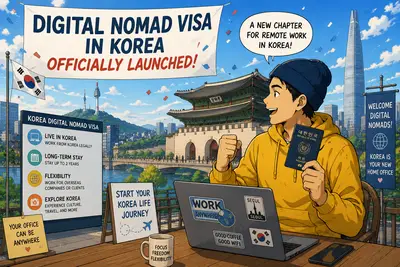
If you are not eligible for the working holiday visa based on your age or country, the digital nomad visa provides another great alternative. I would've applied for this visa myself if it had been available during my journey, but it was announced in 2023. Since then, I've helped many people navigate this visa process successfully.
If you want to stack your visa options strategically, you could take the working holiday visa first, and when that duration ends, apply for the digital nomad visa. This gives you up to 3 years total in Korea while you build your life and network here.
Requirements
- Annual income of at least $84,960 USD (or equivalent in your currency) in the previous year
- Work remotely for a company or clients outside of Korea
- Valid passport with at least 6 months validity
- Proof of income through tax documents, pay stubs, or bank statements
- Health insurance coverage valid in Korea
- Clean criminal record
Why It's Medium Difficulty
While the visa process itself is relatively straightforward, there can be confusion about the requirements, especially regarding the high income threshold. The main challenge is proving your remote work status and meeting the income requirement with proper documentation.
Another source of confusion is about where to file taxes. Since you're earning income from outside Korea while living in Korea, tax obligations can be complex. Best practice would be to consult an international tax consultant who understands both Korean tax law and your home country's tax system.
Key Benefits
- Longer duration: Stay for up to 2 years (1 year initially, renewable for another year)
- No age restrictions: Unlike working holiday visas, there's no upper age limit
- Country-neutral: Available regardless of your nationality (unlike working holiday agreements)
- Work flexibility: Continue working for your existing clients or employer
- Family inclusion: Can bring family members on dependent visas
- Multiple entries: Come and go from Korea as needed
Strategic Advice
If you're already working remotely and earning above the threshold, this is one of the easiest paths to living in Korea long-term. The key is having your documentation in order, especially proof of income and employment contracts or client agreements.
For those who have completed a working holiday visa, transitioning to the digital nomad visa is an excellent next step. You'll already be familiar with life in Korea, have established networks, and can continue building your presence here.
Duration
Initial period of 1 year, with the possibility to extend for an additional year (2 years total)
My Personal Tips
- Prepare thorough income documentation, the more evidence, the better
- Consult an international tax professional before applying to understand your tax obligations
- Keep digital copies of all work contracts and client agreements
- Consider getting health insurance that explicitly covers your stay in Korea
- Join digital nomad communities in Korea for support and networking
- If stacking with working holiday visa, plan the transition before your H-1 expires
Age 30-35 (Established Professional)
🚀 Startup Visa (D-8-4): Build Your Business in Korea
Recommended Age: 25+
Difficulty: Hard
Personal Experience & Recommendation
At 31, I couldn't imagine going back to Korea and somehow driven by an entrepreneurial spirit, I wanted to establish a company in Korea that helps people settle in Korea. Once you understand how running a business works in Korea, you'll realize how straightforward and easy it can be. But the learning curve is very steep, without guidance and help from other mentors, almost impossible.
It's important to network and meet many like-minded people on the same path and share latest information and news about what's going on in Korea. If you are already a freelancer or digital nomad whose business is online anyway, but you want to build your base in Korea, this is the perfect visa to get.
Requirements
- Bachelor's degree or equivalent qualification
- Completion of startup classes or entrepreneurship program in Korea
- Sufficient savings to support yourself and initial business operations
- Business plan demonstrating viability and contribution to Korean economy
- Office space or business address in Korea
Why It's Hard
The learning curve is very steep. Understanding how to run a business in Korea requires navigating complex regulations, tax systems, and business customs. Without guidance from mentors who have been through the process, it can feel almost impossible. You need to be self-motivated, resilient, and willing to invest significant time in learning the system.
Key Benefits
- Build your business base in Korea: Perfect for freelancers and digital nomads who want to establish operations in Korea
- Long-term potential: Can lead to permanent residency if your business succeeds
- Entrepreneurial freedom: Run your own business on your own terms
- Network access: Connect with Korea's vibrant startup ecosystem
- Flexibility: Ideal for online businesses that can operate from anywhere
Strategic Advice
Networking is absolutely crucial for success with this visa. Meet like-minded entrepreneurs who are on the same path, share information about the latest developments in Korea's business landscape, and learn from those who have already navigated the challenges you'll face.
Find mentors who can guide you through the complexities of Korean business operations. Join startup communities, attend networking events, and don't be afraid to ask questions. The Korean startup ecosystem can be incredibly supportive once you tap into it.
Duration
Initial period of 1 year, with extensions possible when meeting revenue goals and business milestones
My Personal Tips
- Take startup classes seriously, they provide valuable insights into Korean business culture
- Build your network before you need it, connections are everything in Korea
- Have sufficient financial runway, don't underestimate initial costs
- Find mentors who have successfully navigated the D-8-4 visa process
- Join entrepreneurship communities and coworking spaces to meet other founders
- Be prepared for a steep learning curve, but know that it gets easier
💼 Work Visa (E-X): Professional Employment in Korea
Recommended Age: 25+
Difficulty: Medium-Hard
Personal Experience & Recommendation
I personally never pursued this route because I didn't want to be employed and sponsored by a company in Korea. However, this is one of the most common pathways for foreigners to work in Korea, especially if you're looking for stability and long-term career growth.
There are various types of E-visas depending on your field: E-1 (Professor), E-2 (Foreign Language Instructor), E-7 (Specially Designated Activities), and others. The E-2 visa is popular for English teaching jobs, while E-7 covers professional expertise in fields like IT, engineering, marketing, and more.
If you already have work experience in your field, it becomes much easier to secure a job offer. However, the best strategy is to network in your field in Korea before even actively looking for positions. Building connections can open doors that job applications alone cannot.
Requirements
- Bachelor's degree (minimum) - Master's or PhD for certain positions
- Relevant work experience in your field (typically 1-3+ years)
- Job offer from a Korean company willing to sponsor your visa
- Valid passport and clean criminal record
- Documents proving qualifications (diplomas, certificates, employment letters)
- For E-2 (English teaching): Native English speaker from designated countries
- For E-7: Demonstrated expertise in specialized field
Why It's Medium-Hard
The difficulty lies not in the visa application itself, but in securing a job offer from a Korean company willing to sponsor you. Companies must prove they couldn't find a qualified Korean candidate for the position, which adds complexity to the hiring process.
Additionally, you're dependent on your employer, if you lose your job or want to change companies, you need to navigate visa transfer procedures. This lack of flexibility compared to other visa types can be challenging.
Key Benefits
- Stability: Long-term employment provides financial security and routine
- Career growth: Build professional experience in the Korean market
- Path to residency: Can lead to F-2 (residence visa) and eventually F-5 (permanent residency)
- Employer support: Company handles visa sponsorship and often provides housing assistance
- Structured integration: Work environment helps you learn Korean business culture
- Healthcare and benefits: Access to Korean national health insurance and employment benefits
Strategic Advice
Network, network, network! Before you start actively job hunting, build connections in your industry within Korea. Attend industry events, join professional groups (both online and offline), and connect with people working in Korean companies.
LinkedIn is particularly valuable for this, reach out to people in your field who are already working in Korea and ask for informational interviews. Many expats are happy to share their experiences and advice.
Consider visiting Korea first on a tourist visa or working holiday visa to attend networking events and even informal job interviews. Having a face-to-face connection significantly increases your chances of getting hired.
Duration
Initial period of 1-2 years, renewable as long as you maintain employment with a sponsoring company
My Personal Tips
- Start networking in your field at least 6 months before you plan to move
- Research companies that actively hire foreigners, some are more open than others
- Learn basic Korean, it significantly improves your job prospects
- Be prepared for the job search to take longer than expected
- Understand your employment contract thoroughly before signing
- Join expat professional communities for job leads and support
- Consider whether you want the stability of employment or the freedom of entrepreneurship before committing
📝 My Strategic Recommendations Based on Life Stage:
Age 18-25 (Student Phase):
- Exchange Program (D-2) → Best for exploring Korea while maintaining university enrollment
- Language Program (D-4) → If you're not in university but want to study Korean
- Working Holiday (H-1) → If you want work experience while exploring
Age 25-30 (Early Career):
- Working Holiday (H-1) → Test-drive life in Korea before committing
- Work Visa (E-7) → If you have 2-3 years professional experience
- Digital Nomad (F-1-D) → If you're already remote working with higher salary income
- Startup Visa (D-8-4) → If you're entrepreneurial and have freelance/business experience
Age 30-35 (Established Professional):
- Startup Visa (D-8-4) → If you're entrepreneurial and have freelance/business experience
- Digital Nomad (F-1-D) → Easiest option if you meet income requirements
- Work Visa (E-7) → If you have significant expertise in your field
Age 35+ (Senior Professional):
- Startup Visa (D-8-4) → Best for long-term business establishment
- Digital Nomad (F-1-D) → If you want less commitment initially
- Work Visa (E-7) → For senior positions and executive roles
- Consider F-2 point-based visa if you meet qualifications (high salary, Korean language, etc.)
Final Thoughts: Choose Your Path Wisely
This is my personal recommendation based on my knowledge and experience. I know everyone's path is different, and there are also way more visas to consider and cover, but this should give you some sort of a base on some of the easier visas you could get in Korea.
While these visas still do not guarantee permanent residency, they are excellent starting points for building your life in Korea. The key is to choose the visa that aligns best with your current life stage, career goals, and personal circumstances.
Remember: the visa is just the beginning. What matters most is how you use your time in Korea to build connections, develop your skills, and create the life you want. Whether you're a student exploring opportunities, a professional building your career, or an entrepreneur establishing your business, Korea has a path for you.
If you have questions about your specific situation or need guidance on which visa might be right for you, don't hesitate to reach out. I'm here to help you navigate this journey.
🏠 Looking for Housing in Korea? Renting Made Easy!
10% Off Service Fee with code:
KIMNINJA10
Enkostay Benefits:
✅ No Deposit ✅ Online Booking ✅ Immigration-friendly docs ✅ Flexible Contracts
Perfect for:
👨🏻💻 Digital Nomads 🎓 Students ✈️ Long-Term Travelers 🧳 Working Holiday
📬 Weekly Tips in Your Inbox
Whether you’re visiting, staying long-term, or relocating. I share honest insights, guides, and tools to help you navigate life in Korea.
Join 1,000+ readers learning how to live smarter in Korea, from visas to vibes.
👋 About Kim Ninja

Kim Ninja (Nguyen Huy Kim)
🧭 Cultural Guide · ✍️ Storyteller · 🎨 Curator
📢 Creator helping foreigners understand and thrive in Korea
🗺️ I turn everyday challenges into comics, guides, and stories
The blog published by Kim Ninja (Huy-Kim Nguyen) is available for informational purposes only and is not considered legal advice on any subject matter.